By starting the design of the lighting installation, you need to have, similar to force installation, so-called. construction bases and precise data on the purpose of all rooms and the requirements for the type of lighting designed. Guidelines for the selection of the type of lighting fixtures and the selected lowest permissible average illuminance are provided in the tables.
We start the calculations of the lighting installation with the selection of the minimum required lighting intensity in individual rooms. Then, using methods, after selecting the type of lighting, we calculate the required number of luminaires for each room. We divide the obtained numbers of luminaires into circuits, guided by the following principles:
— w pomieszczeniach o powierzchni powyżej 100 m2, lighting fixtures should be connected to at least two circuits supplied from different phases,
— do jednego obwodu można przyłączyć 20 incandescent lamps or 30 fluorescent fittings, where plug sockets should be treated like fittings,
— zabezpieczenie obwodu nie powinno mieć wkładki topikowej na prąd znamionowy większy niż 25 A,
— obwody trójfazowe mogą być stosowane tylko w następujących przypadkach:
— urządzenia oświetleniowe będą konserwowane przez fachową obsługę,
— przy wprowadzaniu wielofazowych obwodów do opraw jednofazowych, conductors of unused phases should be led without cutting them in the housing,
— wykorzystanie w oprawach fluorescencyjnych więcej niż jednej fazy może mieć miejsce tylko przy zastosowaniu oprawy wielofazowej,
— powinna być możliwość załączania poszczególnych grap lamp służących do oświetlania części pomieszczeń i tworzących odrębną całość.
In industrial plants, a main switch for basic lighting should be installed in each hall, independently of other switches in the lighting network. The main lighting switch should be installed at the main entrance to the room. If the main light switch is remotely controlled, it can be installed anywhere, the control buttons should be located at the main entrance.
When arranging luminaires on the installation plan, follow the rules.
Having split and arranged luminaires, knowing the power consumed by them and their number, we find the design current of the circuit and select the cross-section and type of conductor, fastener and security, as in the case of power circuits, however, it is assumed that all lighting receivers will work simultaneously.
Minimum cross-section, which can be used in lighting installations and in socket outlet circuits is given in the tables. These circuits are usually derived from a box switchgear located in a room with the highest power installed in lighting devices..
The rules for selecting the number and size of switchboards and their installation locations are the same as in power installations. Using the rules, we find the design current of a group of lighting devices supplied from one switchgear and select the type and cross-section of the wires supplying the switchgear, size and type of cable protection and switches at the exit from the main switchgear and at the entrance to the receiving switchboard.
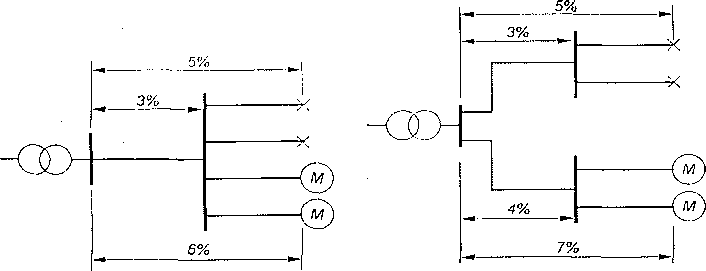 We still have to check, that the permissible voltage drops will not be exceeded in the installation, given in the picture, and the conditions of protection against electric shock.
We now draw a lighting installation plan and its basic diagram, most often performed as a power and lighting installation diagram. The plan and diagram should contain the same descriptions, as stated in the design of the power installation.