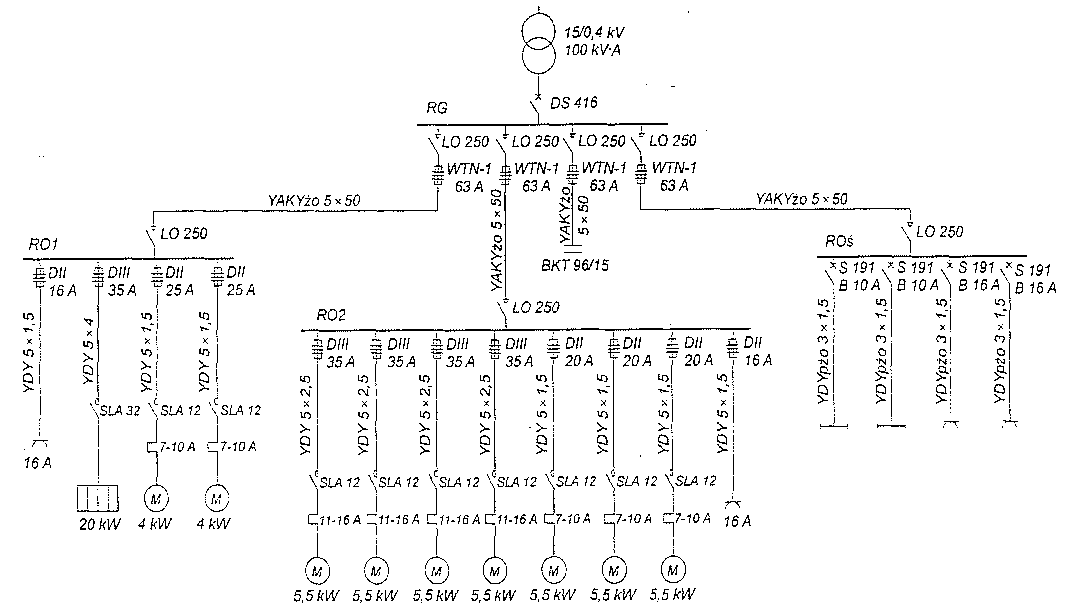
 Scheme of electrical installation of an industrial plant.
Industrial plants can be supplied with electricity:
— z sieci energetyki zawodowej wysokiego napięcia,
— z sieci komunalnej niskiego napięcia,
— z własnej elektrowni.
The method of supplying the plant is determined by factors such as the power demanded by the plant, required certainty of power supply and possible demand by the plant for thermal energy.
Large industrial plants have their own high voltage grid, which supplies power to departmental transformer stations, and from them are powered by low voltage receivers. In the further part of the script, we will deal with an industrial plant powered by a high-voltage utility power grid. The main power supply station of the plant is most often an MV / O transformer and distribution station,4 kV.
The main low-voltage switchgear is supplied from MV / 0.4 kV transformers and then the energy is fed through the low-voltage network to switchgears in individual rooms, and from them power and lighting receivers are powered. An exemplary diagram of the electrical installation of a small industrial plant is given in the figure.
Because most receivers are built on voltage 400 or 230 V, the most common voltage in industrial plants is 400/230 V. This allows power loads with voltage to be supplied from the same network 400 V and lighting receivers with voltage 230 V.
This voltage cannot be used for receivers with a power greater than 250 kW, because such receivers are manufactured for voltage 3 or 6 kV.