 From the point of view of protection against electric shock, there are several types of electric voltage.
The operating voltage is the voltage between conductive parts of an electric circuit and earth or between conductive parts belonging to different poles of an electric circuit.. This voltage may remain constant or intermittent and its value is close to the rated voltage.
The rated voltage is the voltage, for which the electrical equipment or installations have been designed and constructed.
AC rated voltages to 1000 V and DC to 1500 V in accordance with the PN-91 / E standard-05010 divided into two ranges as shown in the table.
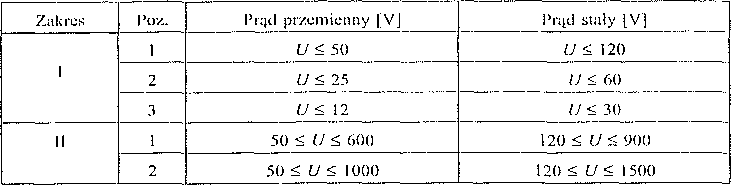 Range 1 tensions (item. 1) was additionally divided into intermediate values. The values are given in the items 2 i 3 refer to specific cases and should be applied depending on environmental conditions (the type of people present in a given environment and their qualifications, human body resistance, contact of people with the potential of the earth).
The limit values given in the table for range II in pos. 1 refer to the voltages between phase and earth or pole and earth in systems with earthing (TN the TT), and the limit values in pos. 2 they refer to the voltages between different phases or different poles of both grounded systems, and isolated.
If, due to insulation damage caused by the earthed device, short-circuit current flows to the ground, voltage will appear on the surface of the earth around the device, the value of which will decrease as the distance from the device increases. In such a situation, dangerous values of touch and step voltages may occur.
The contact voltage is the voltage appearing between the parts simultaneously accessible in the event of insulation failure. The value of the touch voltage depends on the value of the operating voltage and the resistance between the housing of the device and the ground. The contact voltage is usually less than the operating voltage, and its value is the less, the lower the earthing resistance value of the housing of the damaged device. However, if the device, where the insulation is damaged, it is isolated from the ground, this contact voltage can reach the value equal to the operating voltage.
Step voltage is the voltage between two points on the surface of the ground or bench, distant from each other 1 m.
Shock voltage is the voltage drop across the human body during the shock current flow.
Contact voltage is expected to be the highest contact voltage, which may occur in devices or electrical installations in the event of insulation damage, when the impedance value at the fault location is negligible.
Contact voltage allowed (symbol UL) it is the highest value of the touch voltage, which may persist under certain conditions for a long time. The values of touch voltages were adopted as the values of permissible voltages, for which the permissible switch-off time is 5 s. For specific environmental conditions, smaller values of permissible touch voltages were adopted (appropriately 25 V a.c. i 60 V d.c.). Special environments include open areas, bathrooms, showers, sauna, cowsheds and pigsties, production rooms with a relative humidity above 75% and temperatures above 35 ° C or below -5 ° C.