 Loads of electrical installations in residential buildings can be determined on the basis of the rules developed by COBR "Elektromontaż" or on the basis of the rules presented in N SEP-E002.
According to the COOBR "Elektromontaż" method, the power required by one apartment can be determined from the formula
PM = P1 + MP2
wherein: P1 - power of the receiver with the highest consumption installed in the apartment,
P2 - demanded power per one person,
M - number of people, for which the apartment is designed.
As the power of the receiver with the highest consumption P1, should be taken:
- in the case of apartments in buildings equipped with a gas installation - the power of an automatic washing machine
P1 = 2 – 3,5 kW
- in the case of apartments in buildings without gas installations - the power of an electric cooker with an oven
P1 = 7 – 10 kW
Power per one person in the apartment
P2 = 1 kW
When calculating the internal loads on supply lines (wlz) in residential buildings, the power of all apartments supplied from a given internal supply line, determined in the specified manner, should be added up, and multiply the obtained value by the simultaneity factor appropriate for the number of flats supplied from this lz.
The simultaneity factor takes into account both the partial use of the receiver power, and the use of receivers in residential premises at different times. Values of the simultaneity factor, depending on the number of apartments connected to the internal supply line, separately for the case of single-phase and three-phase power supply to flats, see the table.
The power demanded by one apartment according to N SEP-E002 should be taken as equal:
- for apartments without central hot water supply
Sm1 = 30 kV A
- for apartments with central hot water supply
sm2 = 12,5 kV A
In the case of modernized installations in buildings equipped with a gas installation, the power demanded by one apartment can be assumed:
sm3 = 7 kV A
Values of the simultaneity factor for determining peak internal loads on supply lines in multi-family buildings.
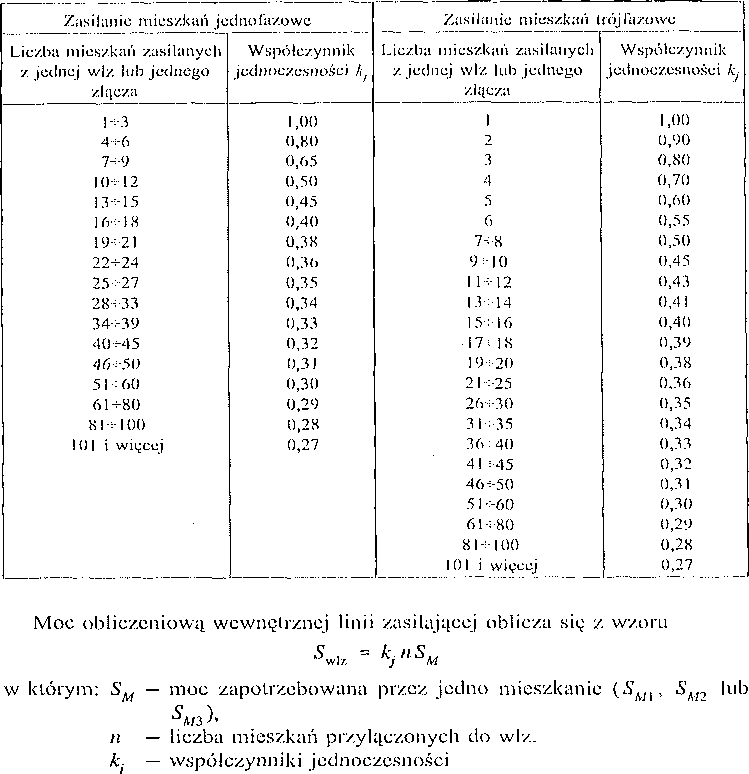 Due to the dominant share in the computing power of heating receivers, the power factor in installations in residential buildings is close to one. Therefore, the apparent power required is practically equal to the active power.
When designing supply lines for non-residential premises, a detailed analysis of the expected load should be carried out each time. The power required for lighting purposes is determined from the lighting calculations, while the power required for other purposes - is determined by the client.
Board. Simultaneity factor to determine the computing power of residential buildings.
| number
apartments |
Values of coefficients of simultaneity in buildings | ||
| no central hot water supply | with central hot water supply | with gas installation, in which the modernization of electrical installations is performed | |
| 1 | 1,0 | 1,0 | 1,0 |
| 2 | 0,733 | 0,880 | 0,929 |
| 3 | 0,61 1 | 0,747 | 0,810 |
| 4 | 0,533 | 0,660 | 0,714 |
| 5 | 0,480 | 0,592 | 0,657 |
| 6 | 0,444 | 0,547 | 0,595 |
| 7 | 0,409 | 0,503 | 0,571 |
| 8 | 0,379 | 0,470 | 0,536 |
| 9 | 0,359 | 0,436 | 0,508 |
| 10 | 0,337 | 0,408 | 0,486 |
| 12 | 0,306 | 0,367 | 0,452 |
| 14 | 0,276 | 0,337 | 0,418 |
| 16 | 0,256 | 0,310 | 0,393 |
| 18 | 0,237 | 0,293 | 0,373 |
| 20 | 0,222 | 0,276 | 0,357 |
| 25 | 0,192 | 0,237 | 0,314 |
| 30 | 0,170 | 0,213 | 0,290 |
| 35 | 0,152 | 0,192 | 0,265 |
| 40 | 0,138 | 0,174 | 0,250 |
| 45 | 0,126 | 0,162 | 0,235 |
| 50 | 0,1 17 | 0,150 | 0,220 |
| 60 | 0,102 | 0,132 | 0,195 |
| 70 | 0,090 | 0,1 17 | 0,176 |
| 80 | 0,081 | 0,104 | 0,161 |
| 90 | 0,074 | 0,094 | 0,148 |
| 100 | 0,068 | 0,086 | 0,137 |
The resultant load of administrative loads in residential buildings is in practice determined as follows:
— obciążenie odbiorów oświetleniowych klatek schodowych przyjmuje się równe sumie mocy zainstalowanych źródeł światła,
- the basement lighting load is assumed to be equal 0,6 the sum of the power of installed light sources,
— The load of cranes in the case of more than one is assumed to be equal 0,8 the sum of the installed power of the engines,
— the load of other force loads is determined in detail, taking into account the nature of these receptions.
When determining the load on a connection in a residential building, the load of all flats supplied from a given connection should be summed up, and multiply the obtained value by the simultaneity factor corresponding to the number of apartments supplied from this connector. To the thus obtained load, the load provided for receivers in administrative rooms should be added, commercial and service and others powered from the same connector.