Types and standards of artificial lighting.
Artificial lighting should ensure sufficient and uniform brightness of the interior of the catering establishment. This lighting is usually incandescent or fluorescent (fluorescent lamps). Bulbs usually give yellow or red light. These colors have a positive effect on the appearance of dishes and the environment. Fluorescent lamps are indeed characterized by a high luminous flux efficiency (much greater than incandescent lamps of the same electric current strength), however, due to the predominance of blue rays, they adversely change the appearance of food and the environment.
Unshielded light sources (bulbs, fluorescent lamps) they catch your eye, they cause glare. Therefore, special light fixtures and various lighting methods are commonly used, as illustrated in the figure.
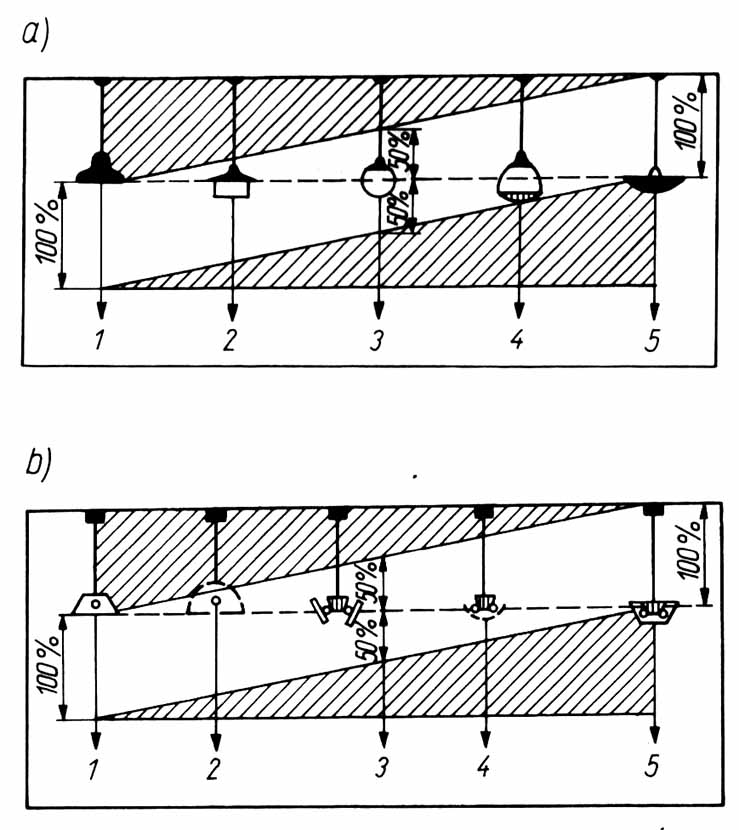
Drawing. Types of luminaires and ways of lighting: a) light bulb holders, b) luminaires for fluorescent lamps: 1 - direct lighting, 2 - mostly direct lighting, 3 - diffused lighting, 4 - mostly indirect lighting, 5 - indirect lighting.
Direct lighting (1) almost provides referral 100% luminous flux directly onto the illuminated surface. This type of lighting is provided by reflector light fixtures. Mostly direct lighting (2) drives 60 ÷ 90% luminous flux directly downwards. The rest of the light falls on the ceiling, which reflects them and directs them down.
Diffused lighting (3) it's so, in which approx. 50% the light is directed at the illuminated plane, and the remainder diffuses into the ambient light.
Mostly indirect lighting (4) it's so, wherein 60 ÷ 90% lighting is achieved by reflecting light off the ceiling. Choosing the type of luminaires and the method of lighting in a catering establishment, the required general or workplace lighting intensity for a given interior should be taken into account.
General lighting provides brightness throughout the room, allowing you to move freely around it and perform various activities, and creates the right mood in the consumption room.
Local lighting provides brightness at a specific point in the room or at the workplace.
Optimum lighting conditions depend on the following factors: sufficient light intensity, sufficient uniformity of illumination, proper luminance distribution (brightness measured in candelas per m² - cd / m²) excluding glare, proper distribution of shadows, the right color of light, harmonious association of lighting with the colors of rooms and technological devices, giving the premises a specific character and atmosphere.
In catering establishments, the lighting of display windows is also used. Please note, so that a large part of the luminous flux falls directly on the surface of the exhibition. Unshielded light sources should not be visible from the street, nor from the premises of the establishment. To meet these requirements, it is indicated here e.g.. direct and reflector lighting fixtures. Direct lighting should be used in rooms with darkly painted ceilings, by situating the light source like this, so as not to create blatant contrasts.
Light source covers or housings should be part of the decoration, harmonized with the design of the entire interior.
Defining lighting standards, it is best to use the illuminance, for it is the only greatness, which does not characterize the light source itself, but the quality of the illumination of some surface. Relatively high intensity of artificial lighting is required in the consumption rooms of catering establishments, amounting 200 ÷ 300 lx. This intensity should be in the back-up and production rooms 50 lx, and over individual work stations 100 lx.
Calculating the illuminance is a preliminary step in designing the type of lighting for a catering establishment. The following relationship can be used for this purpose:
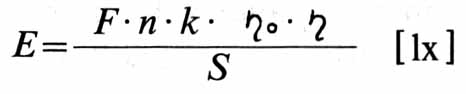
wherein: E - required illuminance in lx;
F - single light source flux in lm;
n - number of installed light sources;
k - inventory factor; k = 0,75 for direct lighting, k = 0,65 for mixed lighting and k = 0,60 for mostly indirect and direct lighting;
theThe - the efficiency of the luminaire is included in the catalog card;
η - lighting efficiency from the appropriate tables, depending on the type of lighting, the type of lighting fixtures and the reflectance (clarity) walls and ceilings ( =0,25÷0,9);
S - room area in m²2.
It is very important from the point of view of costs and electricity savings luminous efficiency different light sources, which should also be taken into account when designing lighting. It is a measure of the conversion of electricity into light expressed in lm / W. And so, e.g.. bulbs are characterized by a luminous efficiency of 8 ÷ 18 lm / W, fluorescent lamps 30 ÷ 50 lm / W, and low-pressure sodium lamps as much as 90 ÷ 135 lm / W.