 Daily load chart of a group of loads with a predominance of lighting loads.
When designing electrical installations, the primary task is to determine the power and energy demand. This is of great technical and economic importance, because these values are the basis for the selection of essential parameters of individual devices, e.g. conductor cross-sections. Despite the existence of detailed methods for determining the expected power and electricity demand, The load values determined at the design stage often differ from the actual loads, that occur after the objects are started. In many cases, it is impossible to precisely determine the power of the connected receivers and the course of their work. The loads on individual network elements vary depending on the nature of the load (residential building, an industrial plant, lighting, heating, etc.), as well as from the season and the day. The figure above shows daily load diagrams of a group of loads with the predominance of lighting receivers in winter, in summer, and in spring and autumn. On the other hand, the figure below shows the daily diagram of the electric network load of an industrial plant.
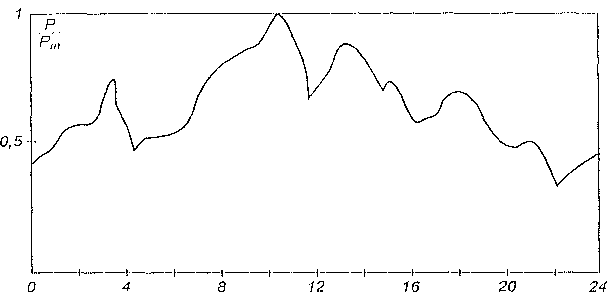 A daily diagram of the electric network load of a three-shift industrial plant.
The greatest load, which will occur in a specific element of the network or electrical installation, we call peak power.
Because at the design stage it is impossible to precisely determine the course of the load of the anticipated loads, in practice, we limit ourselves to determining the highest average value of the load lasting in a sufficiently short time. The selection of the appropriate value of the duration of this load is related to the time constant of the conductors. Wires with a small cross-section have a time constant of a few minutes, while the time constant of conductors with cross-sections from 50 do 185 mm2 is approx 0,2 do 1,2 hours. Due to the necessity to use an easy-to-use calculation, the substitute value of the duration of the largest average load is assumed equal to 15 or 30 min. The discrepancy of the calculation results for both values of the highest average load time is practically small.
In addition, one must take into account a constant increase in energy consumption over time and the greatest load due to the progress of mechanization of all works and the constant expansion of the scope of electricity applications..
Determining the power and electricity demand consists in calculating the expected equivalent load, taking into account the degree of load and the course of load variability of individual receivers over time..