Electrical installations in buildings are used to supply electricity to all consumers of electricity, that can be used in them. These are mainly lighting receivers, various types of heating devices and devices with a motor drive. Electrical installations in buildings should ensure a continuous supply of electricity of appropriate quality. They should also guarantee adequate security for people and property. This primarily applies to protection against electric shock, fire safety and an adequately low noise level, vibrations and the intensity of the electromagnetic field. The buildings are equipped with the following electrical devices:
— złącza elektroenergetyczne,
— urządzenia do samoczynnego załączania rezerwy (SZR),
— rozdzielnice główne budynków,
— rozdzielnice tablicowe na poszczególnych piętrach,
— linie elektroenergetyczne rozdzielcze,
— linie elektroenergetyczne odbiorcze,
— urządzenia do oddzielnych pomiarów energii elektrycznej czynnej,
— rozdzielnice tablicowe mieszkaniowe.
Buildings are usually powered by an external electricity grid. The element connecting the electrical installation with the external power network is the connector. The connector also enables the entire installation to be disconnected from the mains, e.g. in the event of a failure of the installation or during its repair or modernization.
Buildings can be powered by cable or overhead network. In the case of power supply to the building from the cable network, the cable is connected directly to the connector. However, in the case of power supply to the building from the overhead network, there is an intermediate element called the connection. The connection can be cable or overhead.
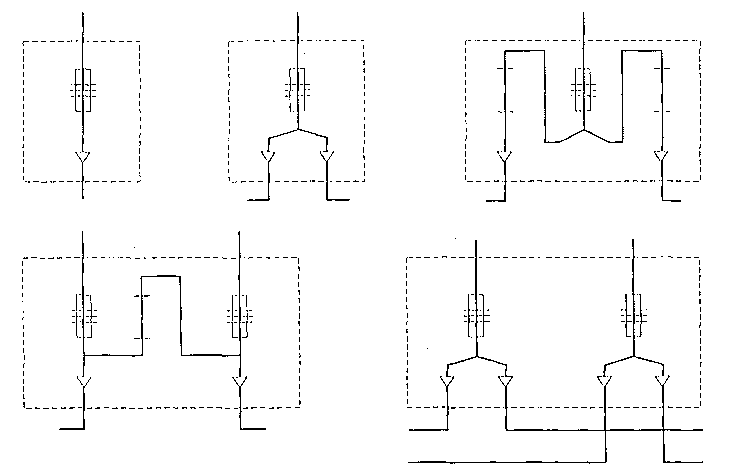
The connectors are installed on the external walls of buildings in easily accessible places. When using an overhead connection, the connector is installed at a height of approx 1,5 m above ground level. The connection between the insulators on the building wall and the joint should be made of insulated wires arranged in the pipe. When using a cable connection, the joint is placed in the recess of the external wall of the building on its side, where is the mains, the lower edge of the recess or connector box should be at a height of at least 15 cm above ground level. The most commonly used connection systems of cable connectors are shown in the figure.