The basis for designing a power installation in an industrial plant is a technological design.
In this project, the detailed location of the load cells and precise data on their number should be provided on the construction background of the plant, size and purpose. We can start designing a power electrical installation with the selection of circuits supplying individual receivers.
We choose the type of cables and the way of arranging them in accordance with the rules, taking into account the construction of buildings.
According to the rules, we select the cross-sections of wires and possibly pipes, and the protection of wires and individual receivers.
Using the rules, we choose the number and locations of switchboards and we select the equipment and arrangement of switchboards. Cast iron distribution boxes are commonly used, relatively tin.
We are now starting to design a low voltage distribution network. We choose the type of cables and the way they are arranged, using, and then, using one of the methods, we determine the design current and select the cross-section of wires and protections as well as connectors on the inlet to the switchgear and outlets from the main switchboard. Then we check, whether in such selected cables the permissible voltage drops will be maintained, which, depending on the type of power supply to the receivers, are shown in the figure.
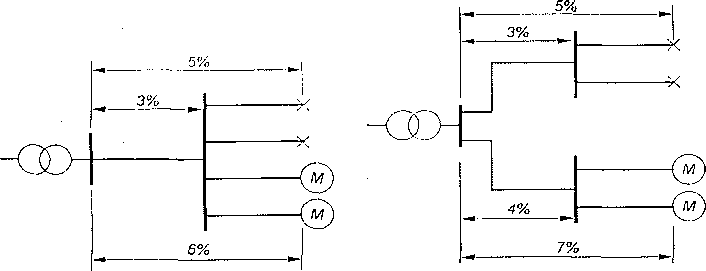 Allowable voltage drops.
We can now make the basic diagram (ideological) power installation and its plan. In the main diagram, we mark the receivers (symbol, power), fasteners (type and size), thermal relays (type and scope), type, the number and cross-section of electrical wiring and pipes.
On the installation plan, we mark the arrangement and labeling of receivers and switchboards, type, the number and cross-section of wires and pipes, cable routes.