Artificial lighting
Just like natural, artificial lighting should ensure sufficient and uniform brightness of the interior of the catering establishment. The artificial light sources used are divided into incandescent and discharge lamps.
Incandescent light sources use the phenomenon of sending light rays under the influence of high temperature. They are vacuum bulbs, carbonated or halogen. The source of radiation in light bulbs is heated to high temperature (under the influence of electric current) tungsten wire (filament). Threaded bases are used to fix the bulbs in the fittings (Edison's thread), bayonet or special.
Discharge light sources use the phenomenon of radiation during electrical discharges in gases and the phenomenon of luminescence. They are the most modern, more efficient and constantly improved light sources. These include fluorescent lamps, mercury lamps, sodium, xenon and high-voltage glow tubes, so-called. "neon lights". Because in some light sources a large part of the radiation is invisible, the so-called. luminofory, which, under the influence of this radiation, emit visible rays. This phenomenon is called fluorescence and is a type of luminescence.
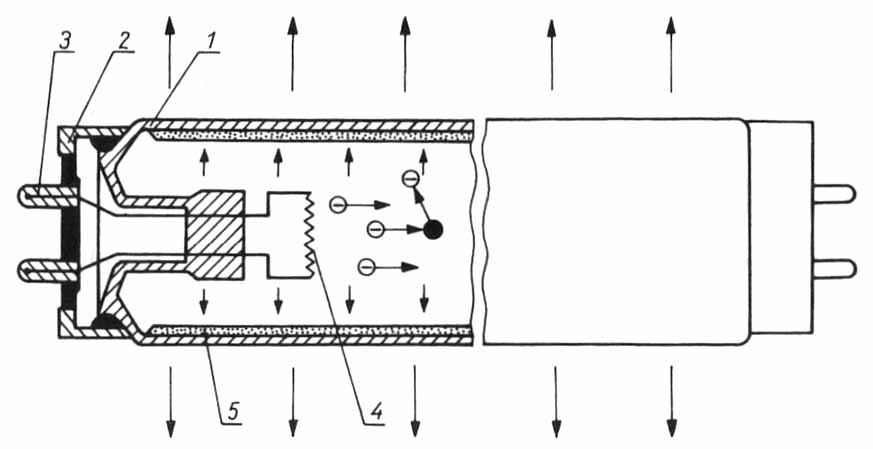
Drawing. Construction of a fluorescent lamp: 1 - glass tube, 2 - shaft, 3 - contact, 4 — electrode, 5 — luminofor.
The figure shows the structure of a typical fluorescent lamp classified as fluorescent light sources. Inside the glass tube there are very low pressure mercury and argon vapors (ok. 3 mm Hg). On both sides of the tube there are glow electrodes with current flowing through them. The potential difference between the electrodes causes the electrons to move in the tube, which collide with mercury atoms, they knock out electrons from their orbits. Mercury ions are a source of strong ultraviolet radiation (invisible). These rays fall on the inner wall of the glass tube covered with a phosphor. The phosphor under the influence of ultraviolet radiation emits visible radiation, that is, light. Ignitors are used to initiate the ignition of the fluorescent lamp. They are discharge lamps, in which one of the electrodes is a bimetallic plate. The diagram of the fluorescent lamp power supply is shown in the figure.
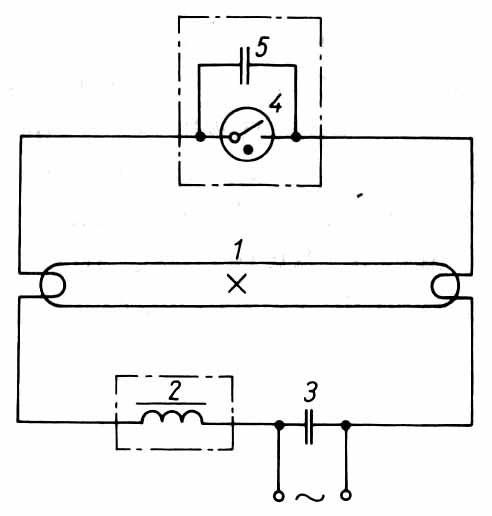
Drawing. Diagram of the fluorescent lamp power supply: 1 - fluorescent lamp, 2 - ballast (stabilizer), 3 - capacitor to improve the power factor, 4 - igniter, 5 - anti-interference capacitor.