Health and safety rules when using the electrical installation.
Operating devices and electrical installations is associated with the risk of electric shock due to the wear and tear of the devices, unforeseen breakdowns or carelessness of the operator. The methods of protection against electric shock are specified in the ordinances of the former Min. Mining and Power Industry and Min. Construction and Building Materials Industry z 31 of December 1968 r. and they relate to the tensions to 1 kV (1000 V).
We include protective measures:
- as primary measures:
• isolating live parts of equipment,
• covers preventing contact with the live part,
• placing live parts in inaccessible or hard to reach places, e.g. On the height,
- as additional measures:
• protective earthing,
• reset,
• anti-shock switches,
• protective insulation,
• protective reduction of operating voltage,
• separation of receivers,
• isolating positions.
Protective earthing consists in connecting a special terminal on the machine housing with a metal object in direct contact with the ground and intended solely for this purpose. (pipe, sheet metal or metal tape buried in the ground). The purpose of grounding is to prevent worker shock when voltage is applied to machine parts, which under normal conditions are not affected by it.
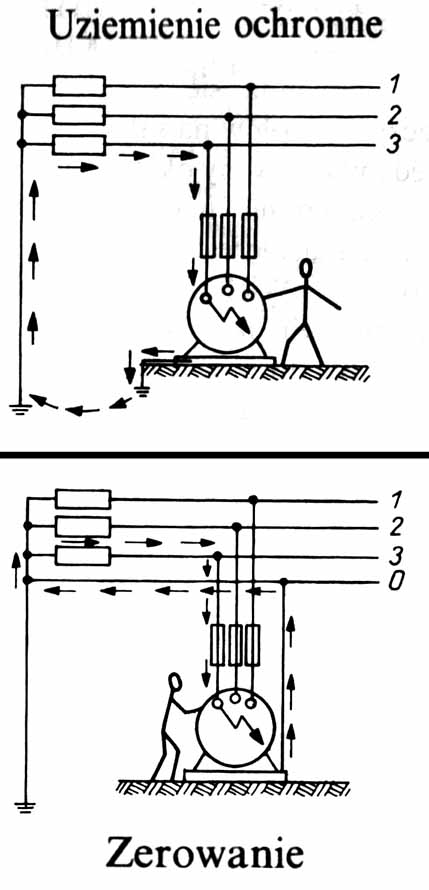
Reset is a factory-made connection of the motor or machine housing with the neutral wire of the network by means of an additional wire, in the power cable. They can be used when connecting motors or machines with motors to a four-wire, three-phase current network with a grounded neutral wire..
It is forbidden to use simultaneously zeroing and earthing of different receivers connected to the same four-wire network.
Protective switches (anti-shock) apply in the case of, when it is not advisable to use grounding or neutralization. As soon as the voltage appears on the machine casing, the power supply to the motor is automatically interrupted. Protective insulation (additional) pose: floor insulation, pavements and gloves worn by employees made of non-conductive and non-absorbing materials, etc..
Protective lowering of the operating voltage is achieved by using step-down transformers to 24 V, which are considered safe for humans. It is most often used to illuminate workplaces in damp rooms and with a large accumulation of metal elements.