Electricity installations are divided into residential and industrial. Installations in small and medium-sized catering establishments and mass catering establishments are also considered residential installations..
Due to the nature of the receivers, installations can be divided into lighting and power installations. Power installations are commonly considered to be installations supplying three-phase motors and heating devices. There are mixed installations in catering establishments, powering both lighting and low-power motors (220 V), driving various machines and devices for the mechanical processing of raw materials and food products, as well as three-phase motors (380/220 V) and heating devices with higher power. In large catering establishments, e.g. central prepress, gastronomic plants, great canteens, there is already a clear division into installations used to supply various groups of receivers.
The electrical installations include: wires, installation accessories, separately, automation devices, e.g. automatic switching on of the reserve. In addition, installations distinguish between certain elements that fulfill certain tasks (drawing).
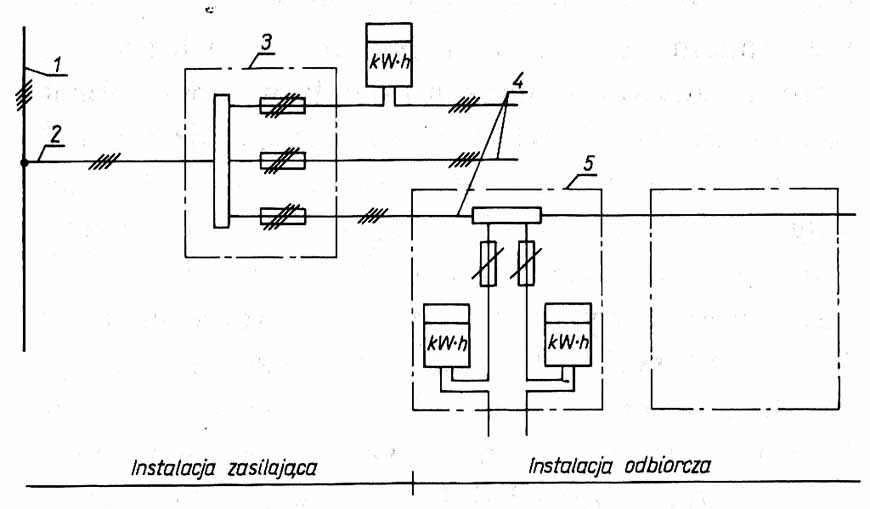
Drawing. Elements of the electrical installation: 1 - energy network, 2 - connection, 3 - connector, 4 - internal power line, 5 - dashboard.
Connection (2) it is a power line connecting the connectors with the commercial power grid.
Connector (3) it is an electrical device used to connect the connection wires to the meter directly or via an internal power line. The connector is the main protection of the powered object. The connection lines are connected to it on one side, and on the other - the wires of the internal power line or the meter.
Internal power line (4) it is a power line with a constant cross-section, connecting the connector with successive switchboards.
Receiving installation (5) it is an installation located behind the meter on the switchboard and supplying electricity to individual receivers.