 Overcurrent protection devices are fuses or circuit breakers with triggers or overcurrent relays..
In the event of a short circuit with negligible impedance between the line conductor and the accessible conductive part or the protective conductor in the circuit, the protective device should automatically interrupt the power supply of the line conductor of the circuit or device at the required time.
The shutdown is fast enough, if it occurs in a time not exceeding the limit values given in the table.
Maximum switch-off times [s]
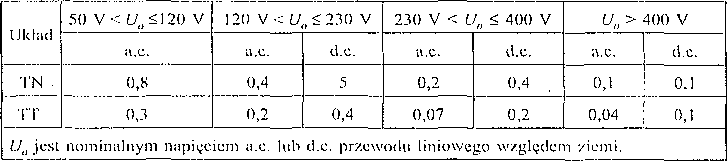 The values of the trip time given in the table concern mainly the end circuits (receiving) with a current not exceeding 32 And in these circuits should not be exceeded.
Switch-off times longer than those given in the table may be permitted in power networks and distribution circuits. This is due to the following assumptions:
— zwarcia w takich obwodach są rzadkie,
— urządzenia zasilane przez takie obwody nie są trzymane w ręku i jeżeli były dotykane, then they can be released in the event of shock current flow.
In TN systems, the trip time should not exceed 5 s. This restriction is contractual.
In TT systems in distribution circuits and in final circuits with a current greater than 32 A is permitted an automatic trip time not exceeding 1 s.
For an IT system, a trip is usually not required when the first fault occurs.
Shorter shutdown times may be required for special electrical installations or special locations according to requirements, contained in part 7 normy HD 60364.
For systems with voltage to earth Uu higher than 50 V a.c. or 120 V d.c. automatic shutdown within the time specified above, respectively for load circuits and for distribution circuits, this is not required, if, in the event of a short circuit with the protective conductor or earth, the voltage of the source is reduced within a time not longer than specified in the table or within 5 s to a value at least 50 V a.c. or 120 V d.c.
.If the conditions for automatic shutdown cannot be met in the installation or its part, it is necessary to apply supplementary protection - additional equipotential bonding. Additional equalizing connections (local) should connect all simultaneously accessible conductive parts and foreign conductive parts. These connections can cover a specific location, part of the installation or the entire installation.
In addition, in AC circuits (a.c.) for:
— gniazd wtyczkowych o prądzie znamionowym nieprzekraczającym 20 A, which are intended for general use and for operation by unqualified persons, and
— urządzeń ruchomych o prądzie znamionowym nieprzekraczającym 32 And for outdoor use, supplementary protection should be provided with residual current devices (RCD).