 Fluorescent lamps called fluorescent lamps are out, next to the light bulbs, the most commonly used light sources. In fluorescent lamps, due to the current flow between the electrodes built into the ends of the glass tube filled with argon and mercury vapor, there is a length of ultraviolet radiation 254 nm. Visible radiation is obtained by covering the inside of the tube with phosphors, which, when exposed to ultraviolet radiation, become a source of visible radiation. By appropriate selection of the phosphor, different colors of light can be obtained.
The advantages of fluorescent lamps include high light efficiency, ok. 33— 70 lm/W, long durability, ok. 6000 h, low brightness and lower dependence of the luminous flux on the supply voltage than in the case of incandescent lamps. The luminous flux of fluorescent lamps varies with voltage.
The life of fluorescent lamps within the voltage limits from 0,93 One do 1,06 Un is practically unchanging. However, the durability of fluorescent lamps depends to a large extent on the frequency of their switching on.
The power consumed by fluorescent lamps depends more on the voltage than the power consumed by the incandescent lamps.
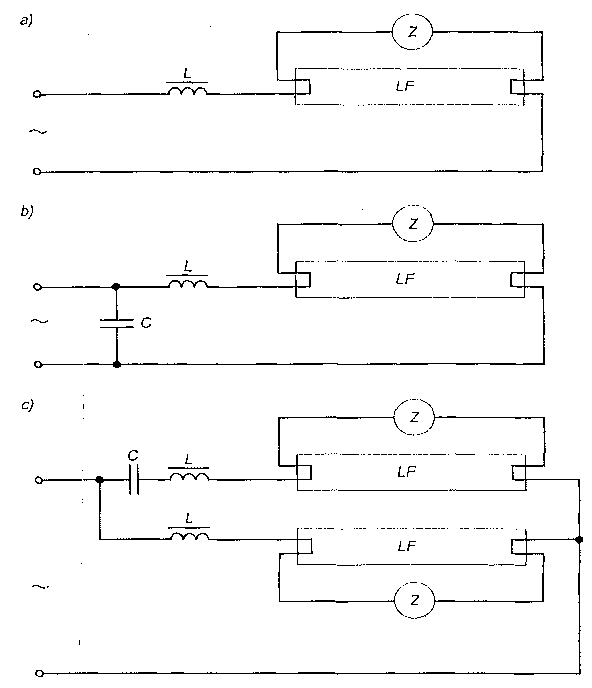 System of connections of fluorescent lamps: a) without reactive power compensation, b) with a capacitor for reactive power compensation, c) antistroboscopic system; LF - fluorescent lamp (fluorescent lamp), Z - igniter, L - ballast (choke), C - capacitor for reactive power compensation.
The serious disadvantages of fluorescent lamps are: the need for auxiliary devices (ballast and igniter), low power factor (ok. 0,5), necessitating the use of compensation capacitors, ripple of the luminous flux and difficult ignition at low temperatures (below -5 ° C) and at reduced voltage. The pulsation of light causes a stroboscopic phenomenon that misjudges the speed of rotation. This phenomenon can be reduced by the use of three-phase lamp power supply systems, attaching adjacent lamps to different phases. With the use of single-phase two-lamp luminaires, this phenomenon can also be reduced as a result of a phase shift in the circuit of one fluorescent lamp in relation to the circuit of the other fluorescent lamp by including a capacitor in the circuit. (Lynx. c).
Wartości znamionowe strumienia świetlnego świetlówek standardowych typu TL-D i świetlówek Super 80 New Generation is given in the tables.
Board. Nominal luminous flux of TL-D standard fluorescent lamps.
| Fluorescent lamp power [W] | Light color and color temperature | ||
| warm white 3000K [lm] | white 4200K [lm] | daily 5400K [lm] | |
| 18 | 1 150 | 1150 | 1050 |
| 36 | 2850 | 2850 | 2500 |
| 58 | 4600 | 4600 | 4000 |
Board. Nominal luminous flux of TL-D Super lamps 80 New Generation.
| Fluorescent lamp power [W] | Light color and color temperature | ||
| warm white 3000K [lm] | white 4000K [lm] | daily 6500K [lm] | |
| 18 | 1350 | 1350 | 1 300 |
| 36 | 3350 | 3350 | 3250 |
| 58 | 5200 | 5200 | 5000 |
In addition to traditional fluorescent lamps, compact fluorescent lamps are increasingly used. Thanks to equipping them with E handles 14 and E27 they can be used as replacements for conventional incandescent lamps. The luminous efficiency of compact fluorescent lamps is 4-6 times greater than that of incandescent lamps. The service life of compact fluorescent lamps is 10 000 h. The luminous flux ratings of compact fluorescent lamps are given in the table.
Board. Rated stream lighting of PL type compact fluorescent lamps
| Power
[W] |
Luminous flux [lm] type lamps | |
| PL* Electronic/C | PL*Eleetronic/T | |
| 9 | 400 | – |
| 11 | 600 | – |
| 15 | 900 | 900 |
| 20 | 1200 | 1200 |
| 23 | 1500 | 1500 |