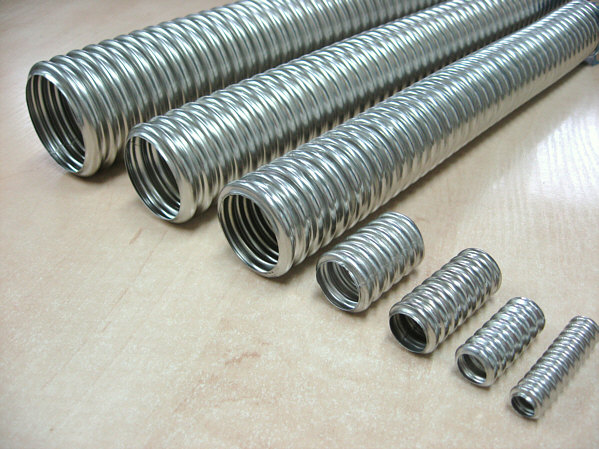
 Installations made with single-core cables in steel pipes laid on the top or in the floor.
This method of laying wires is used in conditions, in which the cables could be mechanically damaged, in ordinary rooms, temporarily humid and not heated, fire-hazardous and potentially explosive (after meeting additional requirements). Steel pipes should not be installed in wet rooms or with caustic vapors.
Pipe fasteners should be placed at distances not greater than 1 m, and at the ends of the tubes approximately 10-15 cm from the end of the tube. Handles, brackets and boxes should be placed by anchoring, fixing with screws to plastered plugs, steel pins driven or driven in or by welding holders or fixing them with clamps to steel structures. Pipe bending should be performed manually or by machine, keeping the radii of curvature given in the table.
Board. The smallest radii of curvature of steel pipes
| Pipe nominal diameter [Mm] | 11 | 13,5 | 16 | 21 | 29 | 36 | 42 |
| Radius of curvature [Mm] | 110 | 140 | 140 | 160 | 200 | 250 | 320 |
Straight sections of pipes with the same diameters are joined by means of sleeves or straight couplings, and pipes of different diameters - with muffs and reduction screws.
Pipes should be laid with a slight slope towards the cans. The cables should be pulled into the pipes after they have been laid. Newer compressed air technology is recommended for this purpose. For large cross-sections, hand winches are used.