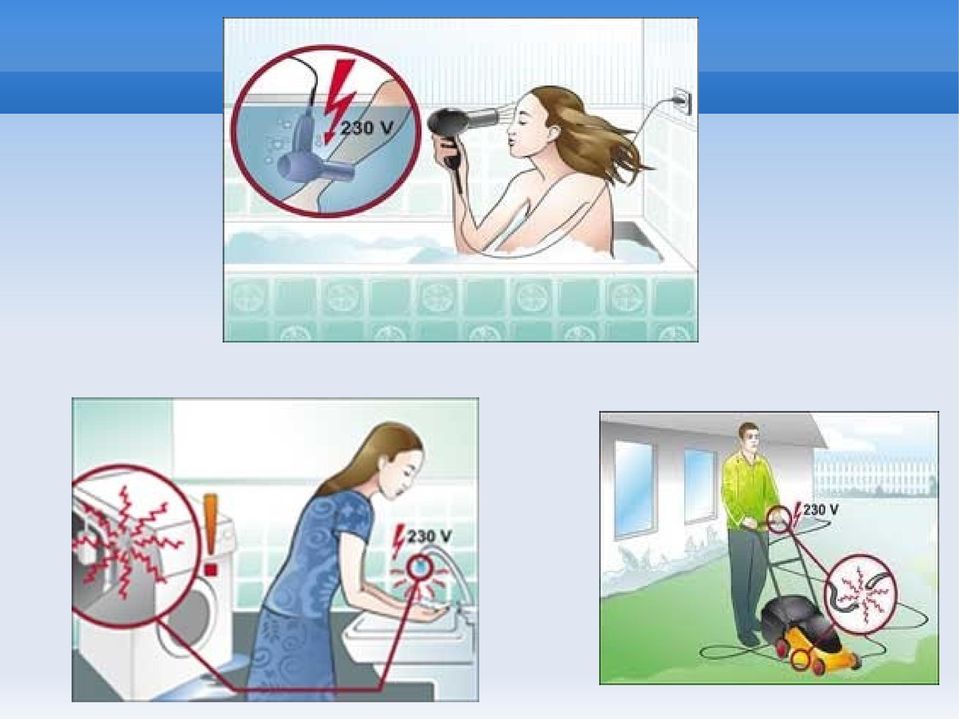
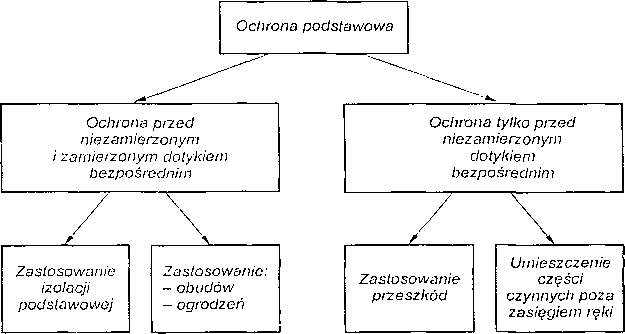
 Basic protection (protection against direct contact) its purpose is to prevent direct contact with live parts.
Primary protection measures are primarily:
— insulation of live parts, these parts should be completely insulated, which can only be removed by destroying it, e.g. insulation of wires and cables,
- fences and enclosures, e.g. placing active parts inside enclosures or fences ensuring the protection degree of at least IPXXB or IP2X, except for cases, when larger holes occur when replacing parts, like for example. in the case of certain luminaires or fuses, or when larger openings are necessary for the proper functioning of the device according to the relevant requirements for this device.
If it is necessary to remove the partitions, opening the housings or removing parts of the housings, these steps should only be possible:
— using a wrench or tool, or
— when the live parts protected by these partitions or enclosures are de-energized.
These measures are intended to prevent both from being unintended, as well as the intended touch of the live parts (direct touch) and can be used in the conditions of normal use of electrical installations.
In addition, they can be used as primary protection measures:
- obstacles, whose task is to prevent the body from unintentionally coming closer to the active parts or touching them,
— placing live parts out of reach, e.g. wires of overhead lines (in the vertical direction the range of the hand is 2,5 m from the surface of the station, on which a man can be).
These measures have a limited scope of application and may only be used in electrical installations under the supervision of qualified or instructed persons and are intended to prevent only inadvertent contact with live parts..
 Unintentional contact is not considered dangerous, if in less than 5 s after turning off the power, the voltage from the static charge will drop below 120 V d.c.
In cases of ineffectiveness of basic protection measures or anticipated carelessness of users of electrical devices, additional RCD devices can be used (The, residual current protectve device) with a trip current not exceeding 30 mA.
These devices are considered as subsidiary protection measures and their use does not exempt one from the obligation to apply one of the listed primary protection measures.